Class of 2006
Holding Out for a Hero ▸ Stiles Stilinski (2)Class of 2006 is the historical cohort that turns a scattered series of murders into a pattern. Its members include the 2006 swim team, the mechanic, the murdered couple, and Isaac Lahey's brother, while Adrian Harris connects several of them through a chemistry class. The cohort's shared past becomes the central clue to the Kanima investigation and ultimately points toward Matt Daehler's revenge campaign.
Discovery Through Records
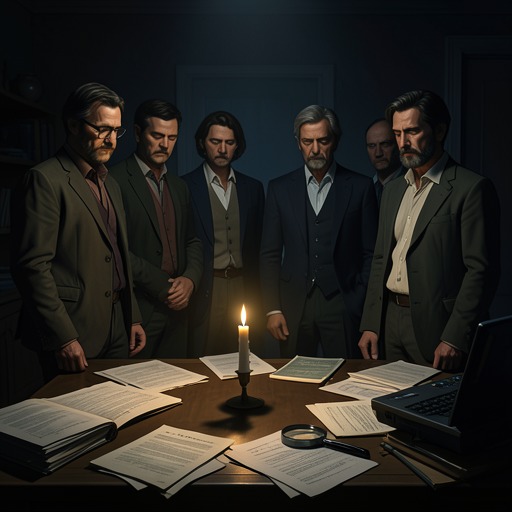
The connection emerges when Stiles Stilinski, Carson Bradley, Scott McCall, and Sheriff Stilinski compare case files and yearbooks. The victims had something in common, and the investigation moves from individual crimes to a search for shared institutional history. A blue folder identifies the class of 2006 as a Beacon Hills group; Isaac Lahey's brother appears among its members, and the records show that the relevant people had attended Beacon Hills together.
The yearbook search sharpens the clue. The group was not merely connected by the town or by an accidental acquaintance: the mechanic, the murdered couple, and the other victims were associated with Adrian Harris's chemistry class. Sheriff Stilinski calls the discovery a pattern and orders the investigators to find the 2006 yearbooks so that every student in that class can be identified by face as well as name. The yearbook therefore functions as more than background documentation. It converts memory into evidence and makes an old school cohort visible as a possible victim list.
The Swim-Team Connection
The decisive refinement is that all the dead people and Isaac Lahey's brother had belonged to the swim team. Stiles Stilinski and Carson Bradley connect this fact to Isaac's father, who had been the swim coach at the time. The investigation consequently narrows from the broad class of 2006 to the specifically targeted 2006 swim team.
The connection also explains the Kanima's behavior. The group suspects that the killer's hatred of the swim team is related to the creature's relationship with water, including the fact that the Kanima does not pursue them once they are in the pool. Water thus links the victims' former identity to the monster's apparent limitation. The old team is not simply a list of people from the past; it is the point where the victims, the coach, the creature, and the investigation's physical clues converge.
From Pattern to Suspect
Once the 2006 swim team is identified as the target, the investigators infer that the Kanima's master specifically hates that team. Stiles Stilinski proposes that the master may be another teacher or student from the period, because the killings appear to arise from an unresolved grievance within the old school community. The question changes from who the victims were to what happened to them together.
The yearbook provides the immediate breakthrough. At Stiles Stilinski's desk, the class photographs are reviewed alphabetically; Matt Daehler's image is found among the students, circled and boxed while other names are crossed out. The visual act of marking the page gives the suspicion a face. Matt Daehler is then treated as the likely controller of Jackson Whittemore's Kanima form, although the investigators still lack a convincing explanation for his connection to every victim.
The physical evidence begins to reinforce the historical pattern. Shoeprints and tire tracks place Matt Daehler at the trailer-park scene and connect him to three murders when the hospital killing is included. A credit-card receipt signed by Matt at the Mechanics garage may connect him to the mechanic's death as well. Surveillance footage from Beacon Hills Hospital is examined for the night Jessica was murdered, but the search is made difficult by a six-car pileup that filled the hospital with people. The old cohort's significance is therefore established through a combination of yearbooks, school records, scene evidence, and incomplete surveillance rather than through a single uncontested clue.
Revenge and Misplaced Responsibility
Class of 2006 becomes the framework for a revenge narrative. Matt Daehler is identified as the person directing Jackson Whittemore to kill, while Jackson functions as the weaponized body through which the killings are carried out. Matt explains the violence as the killing of murderers and insists that the people he has killed deserved it. This claim separates legal responsibility, personal grievance, and supernatural agency: the victims are treated as a collective guilty group, Matt is the directing will, and Jackson is the Kanima used to enact that will.
The investigation never immediately discovers why the 2006 swim team and its coach should be marked for death. Stiles Stilinski, Scott McCall, and Carson Bradley know the who, when, and how before they know the why. They also understand that the supernatural truth cannot be offered to people outside their circle, so the case must be explained through ordinary evidence while the Kanima's existence remains concealed. Class of 2006 consequently operates on two levels: it is a legitimate historical link in the murder case and the hidden structure beneath a supernatural conflict.
Narrative Significance
The cohort gives the murder plot its retrospective shape. Individual deaths initially look unrelated, but the repeated return to school records, the 2006 yearbooks, Adrian Harris's chemistry class, and the swim team turns coincidence into design. Stiles Stilinski's repeated insistence that Adrian Harris was evil gains force when the investigation reveals how the old school network overlaps with the victims and suspects.
The significance of Class of 2006 is also temporal. The victims are pursued because of something associated with an earlier school generation, while the current students must reconstruct that past from folders, photographs, surveillance, shoeprints, tire tracks, and receipts. The past is not finished; it has become an active mechanism governing present deaths. By naming the cohort and isolating its swim team, the investigators transform an atmosphere of random horror into a targeted history of grievance, while the unresolved motive preserves the central uncertainty until the Kanima master's identity is exposed.